Sterlitech vs. Demcon convergence
Sterlitech is a well-established supplier of membrane research products, filtration equipment and laboratory consumables. Their portfolio includes third party membranes, membrane test cells, filtration products and standardized membrane test systems. These solutions provide researchers with tools to evaluate membrane performance and generate experimental data.
Both Sterlitech and Demcon convergence support membrane research and development, but their approach is different. Sterlitech offers standardized membrane testing and process development systems that enable researchers to perform a wide range of experiments. Demcon convergence complements this with advanced automation, software integration and custom-engineered development platforms designed to increase productivity, improve reproducibility and support complex research programmes.
Why researchers start looking beyond membrane test systems
For many membrane researchers, standardized test equipment is a logical starting point. However, as research programmes mature, laboratories often encounter new challenges:
- Researchers spend increasing amounts of time operating equipment
- Experimental workflows become more complex
- Reproducibility becomes essential
- Data management becomes difficult
- More experiments need to be performed with the same team
- Scale-up becomes a key objective
In addition to offering standard membrane test systems, we specialize in custom-engineered membrane development solutions. These systems are designed around the research objectives rather than around a fixed hardware configuration.
Pressure ranges, temperature conditions, material compatibility, flow capacities, automation functionality and process configurations can all be tailored to the specific requirements of the application. This enables researchers to create a development environment that closely reflects real-world process conditions while supporting future process optimization, technology validation and scale-up activities.
This approach enables researchers to perform automated experiments under application-relevant conditions while improving efficiency, reproducibility and data quality. The result is a development platform that not only generates experimental data, but also accelerates process understanding, process optimization and successful scale-up.
The real difference:
testing membranes vs.
developing membrane processes
Both Sterlitech and Demcon convergence provide membrane testing and process development systems. Our approach is built around configurable hardware, powerful automation software and application-specific engineering.
Our systems are frequently used for:
- Membrane screening
- Process optimization
- Fouling studies
- Cleaning optimization
- Long-term stability testing
- Product development
- Process validation
- Scale-up studies
As development programmes become more demanding, software becomes just as important as hardware. Automated test execution, recipe management, data acquisition, experiment scheduling and integrated data logging enable researchers to increase throughput and improve reproducibility.
At the same time, our modular building blocks allow platforms to be configured and extended for application-specific requirements, without having to start from a completely new system design.
By combining standardized platforms, advanced software and custom engineering, we help researchers accelerate membrane process development while maintaining the flexibility to support future research needs.
comparing the approaches.
While both companies support membrane research and process development, the main distinction lies in the level of automation, software integration and application flexibility. Researchers looking for a standardized membrane testing platform may find a ready-to-use solution sufficient. Organizations that need automated workflows, application-specific operating conditions, advanced data acquisition or a path towards scale-up often require a more configurable membrane development platform. The table below highlights some of the key differences between the two approaches.
| Aspect | Demcon convergence | Sterlitech |
|---|---|---|
| System philosophy | Standard and custom-engineered solutions | Standardized product portfolio |
| Custom engineering | Extensive | Standardized product portfolio |
| Automation | Fully automated solutions available | Application dependent |
| Software platform | Dedicated Flow Control Platform included | Data logging and software options available |
| Automated experimental workflows | Extensive | Not prominently featured |
| Recipe-based experimentation | Standard functionality | Available depending on system configuration |
| Industrial instrumentation | Research and industrial-grade instrumentation | Research-focused instrumentation |
| Analytical instrument integration | Custom integration possible | User-configurable |
| Process development focus | Primary focus | Supported |
| Design of Experiments (DoE) | Integrated workflow support | User implemented |
| Data acquisition | Customized and automated | Standardized |
| Scale-up support | Development and scale-up oriented | Laboratory and pilot-scale research |
| Application flexibility | Standard and custom-engineered | Standard configurations |
| Pressure, temperature and chemical compatibility | Configurable to project requirements | Product dependent |
| Typical customer objective | Process optimization, technology development and scale-up | Membrane evaluation and process research |
| Prototype-to-production capability | Yes, core business | Limited visibility |
| Series manufacturing of custom systems | Yes, core business | Limited visibility |
why these features matter.
For many research groups, the most expensive resource is not the equipment. It is researcher time. A typical membrane project may require hundreds of hours of:
- Adjusting operating conditions
- Recording measurements
- Managing experiments
- Running cleaning procedures
- Monitoring long-duration tests
- Processing data
These activities are valuable but often repetitive. Demcon convergence platforms are designed to automate these routine tasks.
Through advanced control and workflow automation, complete experimental campaigns can be executed unattended and automatically, including:
- Membrane conditioning
- Pressure variation studies
- Crossflow variation studies
- Automated cleaning procedures
- Fouling experiments
- Overnight operation
- Multi-day experiments
Researchers spend less time operating equipment and more time interpreting results.
start automating complex workflows.
Many membrane test systems include monitoring and recording capabilities. Sterlitech additionally offers a dedicated Expanded Benchtop Data Logging Kit with trend charts, conductivity measurement, permeate flow monitoring and data export via SD card or Ethernet. At Demcon convergence, software is not an add-on. Software is an integral part of the platform.
The Fluid Control Platform (FCP) is the software backbone of every Demcon convergence membrane development platform. FCP is far more than a conventional HMI or data logging package. It does not simply record what happened during an experiment. It actively manages and automates the experiment itself. This distinction becomes increasingly valuable as research programmes grow in complexity.
It enables researchers to:
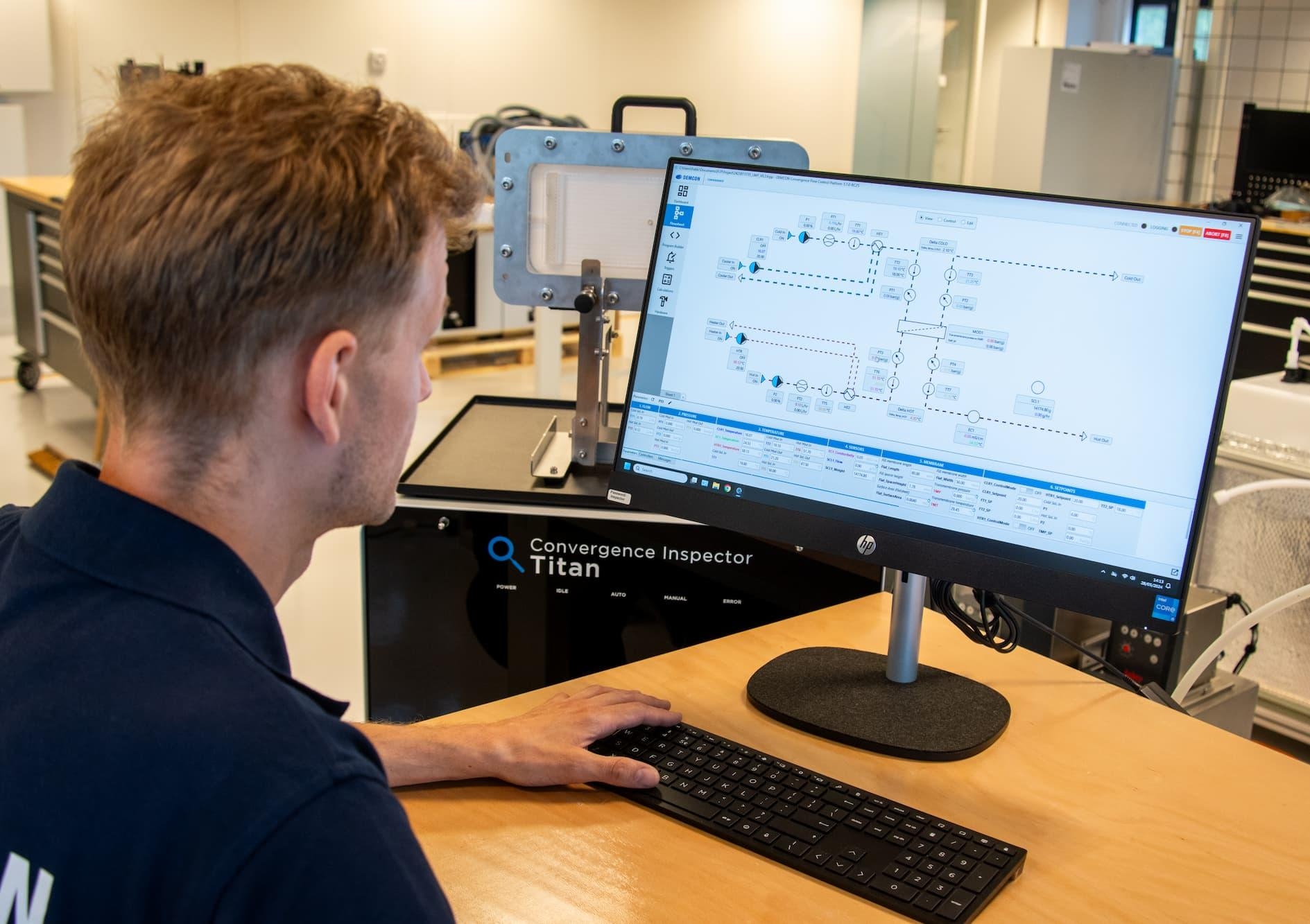
Schedule automated experiments
Execute multi-step workflows
Log process data continuously
Monitor experiments in real time
Export structured datasets
Create test recipes without programming
Automatically control pumps and valves

Standardise procedures across teams and locations
ready to accelerate your membrane development?
